

Three Passes Trek 2026: Complete Guide to Nepal’s Ultimate Adventure
For those who find the standard route to Everest Base Camp a bit too “traveled,” the Three Passes Trek 2026 offers the ultimate challenge. Often called the “Grand Circle” of the Khumbu region, this trek isn’t just a walk; it’s a high-altitude odyssey that links four stunning valleys and crosses three of the most dramatic mountain passes in the world.
In 2026, the Everest region is more accessible yet more focused on sustainability than ever before. With upgraded digital permit systems and a commitment to eco-friendly trekking, there has never been a better time to test your limits against the giants of the Himalayas.
At Lynx Adventure Tour, we’ve seen how this trek transforms people. Here is everything you need to know to conquer the ultimate Himalayan loop this year.
What Makes the Three Passes Trek Special?
Most trekkers fly into Lukla with one goal: Everest Base Camp. But the Three Passes Trek 2026 offers so much more. By diverging from the main trails, you experience the “real” Khumbu isolated Sherpa villages, hidden turquoise lakes, and 360-degree views that most visitors never see.
The trek is defined by its three high-altitude giants:
- Kongma La (5,535m): The highest and often considered the toughest of the three.
- Cho La (5,420m): Famous for its technical glacier crossing and rocky scrambles.
- Renjo La (5,360m): Renowned for providing arguably the best panoramic view of Mount Everest and the Gokyo Lakes together.
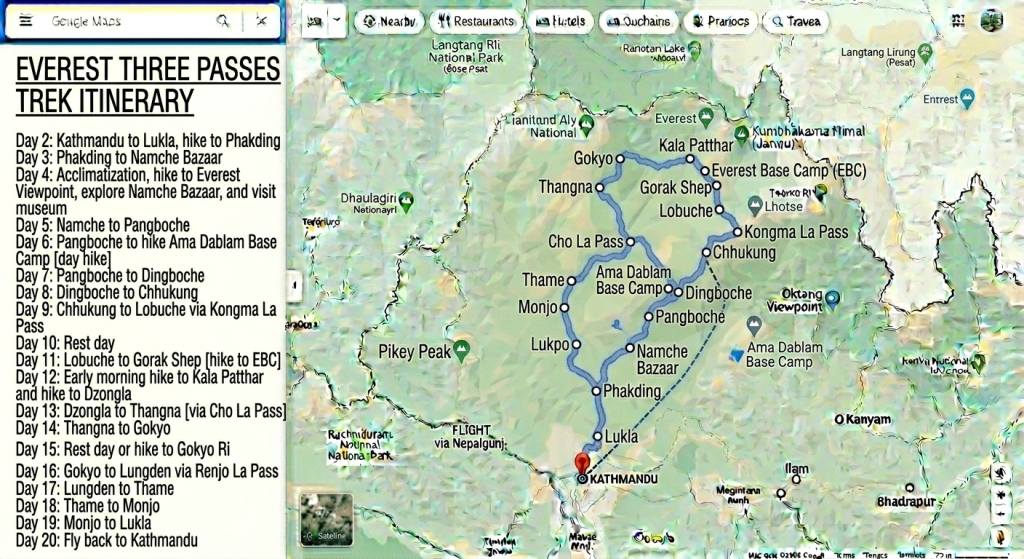
The 2026 Itinerary: A Balanced 21-Day Journey
Success on the Three Passes Trek 2026 is 5% fitness and 90% acclimatization. A rushed itinerary is the fastest way to a headache or worse. We recommend a 20 -day circuit to allow your body to adapt.
Day 1: Arrival & Preparation in Kathmandu
- Altitude: 1,400m
- Description: Your journey begins in the vibrant capital. Meet your trekking team, finalize permits, and do a final gear check in the bustling streets of Thamel.
Day 2: Kathmandu to Lukla & Trek to Phakding
- Altitude: 2,860m (Lukla) to 2,610m (Phakding)
- Distractions: Experience the “heart-in-your-throat” flight to Lukla, one of the world’s most scenic mountain airstrips. The trek begins with a gentle descent, passing Mani stones and prayer wheels while following the Dudh Koshi River.
Day 3: Phakding to Namche Bazaar
- Altitude: 3,440m
- Distractions: Enter the Sagarmatha National Park at Monjo. After crossing the high Hillary Suspension Bridge, tackle the famous “Namche Hill” to reach the horseshoe-shaped Sherpa capital.
Day 4: Acclimatization Day: Everest View & Museum
- Altitude: 3,440m (Stay) / 3,880m (Hike)
- Distractions: A crucial day for altitude adaptation. Hike up to the Everest View Hotel for your first panorama of Everest, Lhotse, and Ama Dablam. Visit the museum to learn about Sherpa culture and the history of mountaineering.
Day 5: Namche Bazaar to Pangboche
- Altitude: 3,930m
- Distractions: The trail winds around the mountainside with spectacular views. You’ll bypass the busier Tengboche and head straight to Pangboche, home to the oldest monastery in the Khumbu region.
Day 6: Day Hike to Ama Dablam Base Camp
- Altitude: 4,600m (Base Camp)
- Distractions: A spectacular side-trip to the foot of the “Mother’s Necklace” Ama Dablam. This is a quiet, powerful place away from the main trails where you stand directly under soaring granite walls.
Day 7: Pangboche to Dingboche
- Altitude: 4,410m
- Distractions: Enter the high alpine zone where trees disappear, replaced by low shrubs and soaring ice walls. Dingboche is protected by ancient stone walls designed to shelter crops from high-altitude winds.
Day 8: Dingboche to Chhukung
- Altitude: 4,730m
- Distractions: A short day to prepare for the first pass. Chhukung is nestled in a glacial valley surrounded by massive glaciers and the towering south face of Lhotse.
Day 9: Chhukung to Lobuche via Kongma La Pass
- Altitude: 5,535m (Pass) to 4,940m
- Distractions: The First Pass. Kongma La is the highest and toughest of the three. It is a rugged, wild climb over rocky moraines with a surreal view of the Khumbu Glacier from the top.
Day 10: Rest Day in Lobuche
- Altitude: 4,940m
- Distractions: After the intensity of Kongma La, this is a vital day for recovery. Hydrate, eat well, and prepare for the Base Camp push tomorrow.
Day 11: Lobuche to Gorak Shep & Everest Base Camp
- Altitude: 5,164m (Gorak Shep) to 5,364m (EBC)
- Distractions: Trek alongside the Khumbu Glacier to Gorak Shep. Continue to Everest Base Camp to stand at the edge of the Khumbu Icefall, the pinnacle of the Everest experience.
Day 12: Kala Patthar Sunrise & Trek to Dzongla
- Altitude: 5,545m (Kala Patthar) to 4,830m
- Distractions: A pre-dawn climb to Kala Patthar for the ultimate Everest sunrise. Afterward, trek toward Dzongla, a quiet spot at the foot of Cholatse, to prepare for the next pass.
Day 13: Dzongla to Thagnak via Cho La Pass
- Altitude: 5,420m (Pass) to 4,700m
- Distractions: The Second Pass. Cho La involves a scramble and a walk across a flat glacier. It’s an icy, thrilling adventure that leads you into the beautiful Gokyo Valley.
Day 14: Thagnak to Gokyo
- Altitude: 4,790m
- Distractions: Cross the massive Ngozumpa Glacier, the longest in the Himalayas. On the other side, the stunning emerald-blue third lake of Gokyo awaits.
Day 15: Rest Day or Hike to Gokyo Ri
- Altitude: 5,357m (Gokyo Ri)
- Distractions: A day for exploration. Hike to Gokyo Ri for a panorama that includes four 8,000m peaks: Everest, Lhotse, Makalu, and Cho Oyu.
Day 16: Gokyo to Lungden via Renjo La Pass
- Altitude: 5,360m (Pass) to 4,370m
- Distractions: The Third Pass. Renjo La offers arguably the best view of Everest because you can see the mountain and the Gokyo Lakes together. Descend into the remote Bhote Koshi Valley.
Day 17: Lungden to Thame
- Altitude: 3,820m
- Distractions: Descend through ancient trade routes used by Tibetan salt traders for centuries. Thame is a historic village and the home of many legendary Sherpa mountaineers.
Day 18: Thame to Monjo
- Altitude: 2,835m
- Distractions: The air feels thicker and warmer as you drop below the tree line. Bypass Namche and settle into Monjo, exiting the National Park.
Day 19: Monjo to Lukla
- Altitude: 2,860m
- Distractions: Your final day on the trail. Retrace your steps back to Lukla and enjoy a “Victory Dinner” to celebrate your incredible 3-pass achievement.
Day 20: Fly back to Kathmandu
- Distractions: An early morning flight back to the capital. After 20 days in the wild, a hot shower and the comforts of the city will feel like pure luxury.
Essential Travel Tips for 2026
1. New Digital Permits (E-TIMS)
For 2026, Nepal has fully transitioned to the Centralized Digital Trekking Portal. Physical TIMS cards are a thing of the past. Your permit is now a QR code that will be scanned at checkpoints like Monjo. Ensure your trekking agency (like Lynx Adventure Tour) has registered your details and uploaded your mandatory insurance to the portal.
2. Mandatory Insurance Requirements
The Nepal government now strictly enforces insurance verification for high-altitude treks. Your policy must cover:
- Altitudes up to 6,000m.
- Emergency helicopter evacuation.
- Search and rescue operations.
3. Sustainability: The Plastic Ban
The Khumbu region has banned single-use plastic water bottles. Bring a durable Nalgene or insulated bottle and a high-quality water purification system (like a Grayl or LifeStraw). This not only saves the environment but also saves you a significant amount of money on the trail.
Physical and Mental Preparation
The Everest High Passes trek is classified as strenuous. You will be walking 6 to 9 hours a day for nearly three weeks.
- Fitness: Focus on stair climbing, long-distance hiking with a pack, and leg-strengthening exercises (squats and lunges).
- Mental Toughness: The passes are as much a mental game as a physical one. Be prepared for cold mornings, basic accommodation, and the grit required to reach 5,500m.
FAQs: Three Passes Trek 2026
1. Is the Three Passes Trek harder than Everest Base Camp?
Yes, significantly. While the EBC trek follows a well-trodden, gradual path, the Three Passes Trek involves steeper ascents, crossing glaciers, and staying at higher altitudes for a longer period.
2. Do I need crampons or technical gear?
You don’t need full mountaineering gear, but micro-spikes are highly recommended for Cho La Pass, especially if there is recent snow or ice. A good pair of trekking poles is non-negotiable.
3. Can I do this trek solo in 2026?
While solo trekking is technically possible in some parts of Nepal, the 2026 regulations highly encourage (and in some restricted sections, require) a licensed guide. For a trek this technical and remote, we strongly advise against going alone for safety reasons.
4. What is the best month for the Three Passes Trek in 2026?
October and November offer the clearest skies and most stable trail conditions. April and May are also excellent, with blooming rhododendrons at lower elevations and warmer temperatures.
5. How much does the Three Passes Trek cost?
In 2026, expect a budget between $ 2,000 and $ 2700 USD. This includes permits, flights to Lukla, a guide, a porter, accommodation, and meals.
Conclusion: Are You Ready for the Ultimate Circuit?
The Three Passes Trek 2026 is more than just a hike, it’s a badge of honor. It’s for the adventurer who wants to see every angle of the world’s highest peaks and experience the raw beauty of the Khumbu in its entirety.
At Lynx Adventure Tour, we handle the complexities of the 2026 digital permits and logistics so you can focus on the trail ahead. Are you ready to cross the three giants? Contact us today to book your 2026 Himalayan expedition!



Comments are closed